

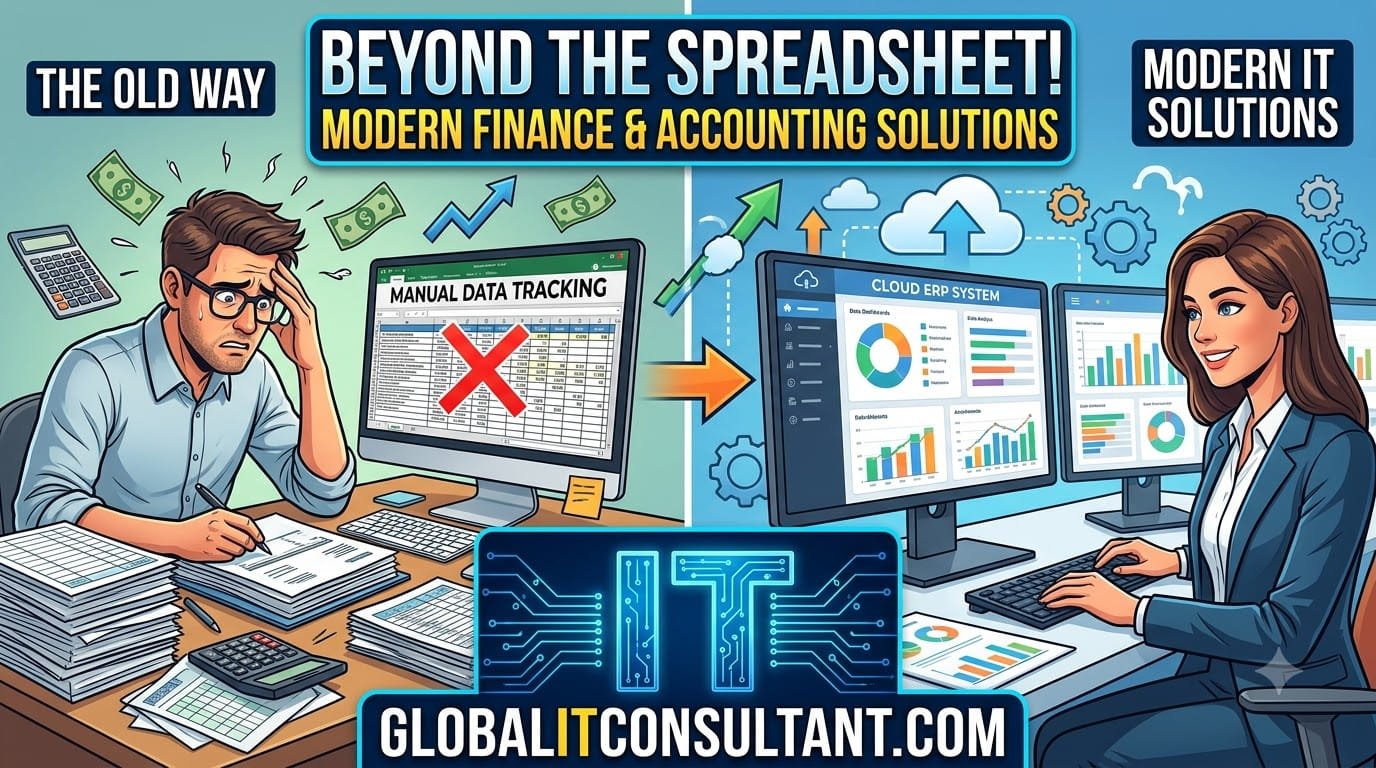

A client once told me, half-joking, that their previous bookkeeping setup consisted of “three spreadsheets, a shoebox of receipts, and hoping the accountant remembered what happened in March.” That’s more common than most business owners would admit publicly, and it’s exactly why I want to write about something that doesn’t get talked about enough when businesses think about finance and accounting support: the actual technology infrastructure sitting underneath the numbers.
Most conversations about accounting services focus entirely on the accounting itself — who’s doing the bookkeeping, who’s filing the taxes, who’s running payroll. What gets overlooked is that the quality, security, and usefulness of all of that work depends heavily on the IT systems supporting it. A great accountant working on a fragmented, poorly integrated tech stack will still produce delayed reports, reconciliation errors, and compliance gaps. A well-designed technology foundation, on the other hand, turns finance and accounting from a backward-looking record-keeping function into a genuine strategic asset.
I’m Ankit Srivastava, and this is exactly the intersection our team at Global IT Consultant works in — combining real accounting and financial expertise with the IT infrastructure, automation, and reporting systems that make that expertise actually usable day to day. I want to walk through what that technology layer actually looks like in practice, across the core services businesses typically need.
Bookkeeping & Accounting: Where Automation Quietly Does the Heavy Lifting
Bookkeeping sounds like a purely manual, human task — and historically, it largely was. Today, the real value comes from pairing skilled accountants with the right automation infrastructure underneath them.
Cloud-based accounting platforms like QuickBooks Online and Xero form the foundation, but the IT work that actually makes them valuable involves connecting bank feeds securely, setting up automated transaction categorization rules, and building reconciliation workflows that flag discrepancies immediately rather than surfacing them weeks later during a manual review. We regularly set up integrations between a client’s point-of-sale system, e-commerce platform, and accounting software so that transactions flow through automatically and accurately, instead of someone manually re-entering the same data across three disconnected systems — which is exactly where a lot of small business bookkeeping errors originate in the first place.
Document management and audit-readiness is the other half of this. Secure, cloud-based receipt and invoice capture — where a photo of a receipt gets automatically extracted, categorized, and attached to the right transaction — has genuinely transformed how audit-ready a business’s books can stay year-round, rather than becoming a frantic scramble every time tax season or an actual audit approaches.
Payroll Management: Where Compliance Risk and IT Infrastructure Meet Directly
Payroll is one of the areas where I’ve seen the IT layer matter most directly, because payroll compliance failures carry real financial and legal consequences, not just inconvenience. One of our clients — a manufacturing group managing payroll across multiple physical locations — described their previous process as a genuine operational nightmare before we implemented automated payroll systems that handled multi-location tax jurisdiction rules, compliance filing, and employee compensation processing in a unified, reliable workflow.
The technical work behind this involves integrating payroll software with time-tracking systems, HR platforms, and accounting software so that hours worked, tax withholding, and benefits deductions flow through automatically and consistently, rather than requiring manual reconciliation between disconnected systems every single pay period. It also means building in the compliance logic that correctly applies different tax rules across jurisdictions — genuinely complex for any business operating across multiple states or regions, and exactly the kind of rules-based automation that reduces both human error and the compliance risk that comes with it.
Financial Reporting & Forecasting: Turning Raw Data Into Something Leadership Can Actually Use
This is where finance and accounting work shifts from historical record-keeping into genuine strategic value, and it’s an area I have particular hands-on investment in, given my broader background in business intelligence and data analytics consulting. One of our logistics clients needed a more robust financial reporting system, and the solution involved building custom Looker Studio dashboards that gave their leadership team real-time visibility into key financial KPIs — cash flow, margin by service line, outstanding receivables — without waiting on a manually compiled monthly report.
The underlying IT work here involves consolidating financial data from accounting software, banking systems, and operational tools into a single, reliable reporting layer, then building dashboards and forecasting models tailored to the specific decisions a business’s leadership actually needs to make. This is the same discipline I’ve written about in the context of executive-level business intelligence — the technology only creates real value when it’s built around actual decision-making needs, not just because dashboards look impressive in a demo.
Tax Preparation & Compliance: Where Data Accuracy Upstream Determines Everything Downstream
Tax compliance is frequently treated as a once-a-year event, but the IT infrastructure supporting it needs to function accurately all year round, because tax preparation is only as good as the underlying financial data feeding into it. If bookkeeping, payroll, and financial reporting systems are properly integrated and consistently accurate throughout the year, tax preparation becomes a matter of organizing already-clean data rather than untangling a year’s worth of accumulated inconsistencies under deadline pressure.
This is genuinely where I see the clearest return on investing in proper financial IT infrastructure early — businesses with well-integrated systems consistently report smoother, faster, less stressful tax preparation than those trying to reconstruct accurate records from fragmented data sources every spring.
Why We Approach This as an IT Problem, Not Just an Accounting Problem
Here’s the perspective I bring specifically, coming from an IT and technology consulting background rather than a purely accounting one: most of the recurring frustrations businesses have with their financial processes — delayed reporting, reconciliation errors, compliance risk, painful tax season scrambles — trace back to gaps in how their financial systems are integrated and automated, not to a lack of accounting expertise on their team.
Security and compliance are built into the infrastructure, not bolted on afterward. Financial data is sensitive by definition, and our approach follows industry-leading data security and regulatory compliance practices from the start — encrypted data handling, proper access controls, and secure integrations between systems — rather than treating security as a separate concern from the accounting work itself.
Tailored systems beat generic templates. A tech startup preparing for investor meetings has fundamentally different reporting needs than a multi-location manufacturing group managing complex payroll compliance. The right IT solution reflects the specific business type, size, and industry, rather than forcing every client into the same generic accounting software setup.
Cost-effectiveness comes from doing the integration work properly once. A well-integrated financial technology stack consistently costs less to maintain over time than a patchwork of disconnected tools requiring constant manual reconciliation — the upfront investment in proper integration pays for itself in reduced ongoing labor and error correction.
What This Looks Like for a Real Business
Bringing this back to something concrete: a tech startup we worked with came to us with genuinely chaotic financial records — the kind of situation where nobody could confidently answer basic questions about cash position or burn rate without days of manual reconciliation. Beyond just cleaning up their books, we built the underlying systems and reporting structure that let them walk into investor meetings with clear, credible financial reporting they could stand behind confidently — a good example of how the technology layer directly translates into a real business outcome, not just cleaner spreadsheets for their own sake.
Final Thoughts
Finance and accounting support is often evaluated purely on the expertise of the people doing the work, which matters enormously — but the technology infrastructure underneath that expertise determines whether it actually translates into timely, accurate, secure financial operations or gets bottlenecked by manual processes and disconnected systems. Our approach combines experienced accounting professionals with the IT integration, automation, and reporting infrastructure that lets that expertise actually function at its best, tailored to your specific business rather than forced into a generic template.
If your business is dealing with fragmented financial systems, delayed reporting, payroll compliance headaches, or tax season chaos, it’s worth a real conversation about where the technology layer might be the actual bottleneck. Learn more about our Finance & Accounting Services and see how the right IT foundation can turn your financial operations from a recurring source of stress into a genuine strategic advantage.
