

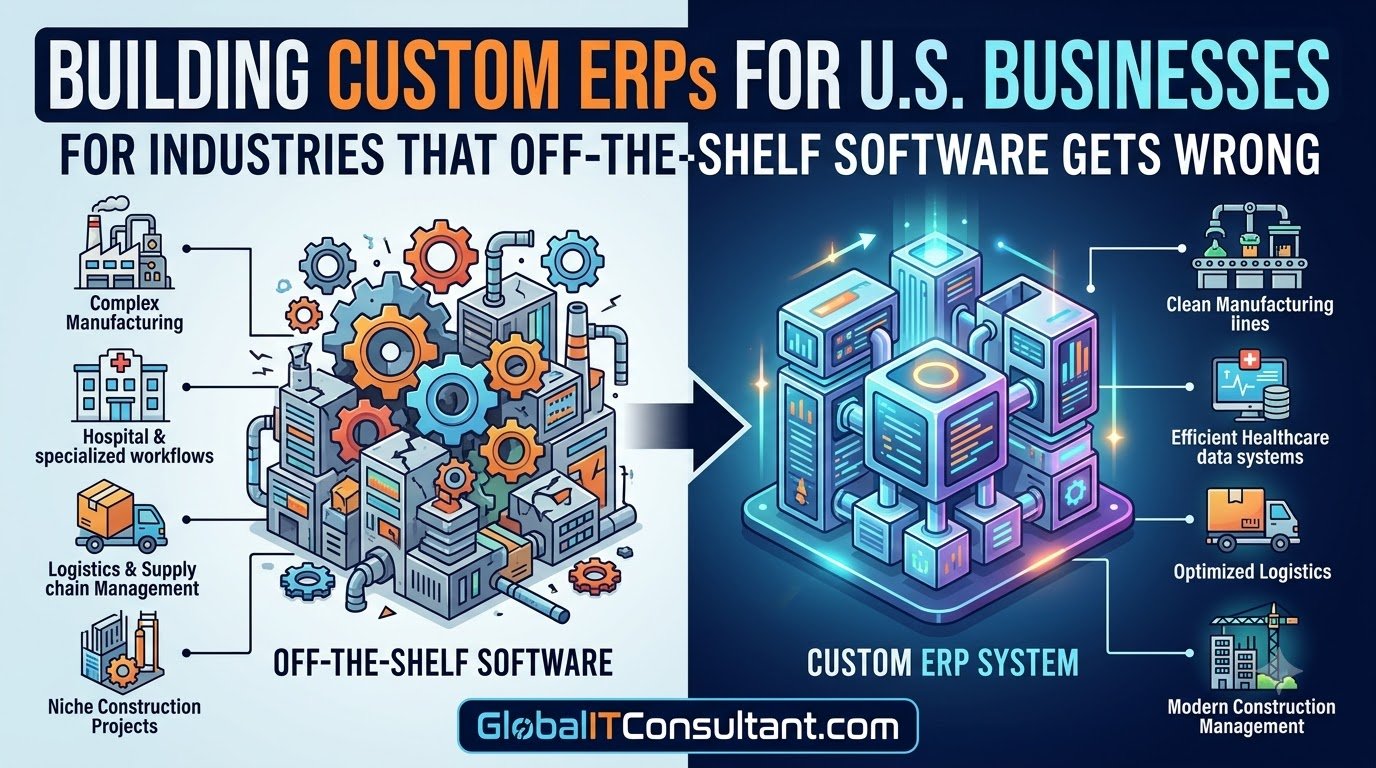

Early in my career, before I was running consulting engagements, I worked as part of an internal development team building an ERP system for a jewelry manufacturing operation in California. It’s an industry most software vendors have genuinely never thought carefully about — tracking raw precious metal weights through multiple stages of casting, polishing, and setting, reconciling gemstone inventory down to the carat, managing consignment relationships with retailers, and handling pricing that fluctuates with daily gold and silver spot prices. Every generic inventory or manufacturing ERP we evaluated at the time handled maybe 60% of what the business actually needed, and the remaining 40% was exactly the part that mattered most to how that business actually made money.
That experience shaped how I think about ERP development to this day. Off-the-shelf ERP software is built to serve the widest possible range of businesses reasonably well, which almost always means it serves your specific business only adequately. A custom-built ERP, built around how your business genuinely operates rather than how a software vendor imagined businesses in your general category might operate, consistently produces a system your team actually uses well, rather than one they work around.
I’m Ankit Srivastava, and building and overseeing ERP development across a genuinely wide range of industries has been one of the more consistent threads throughout my career. I want to walk through how we approach building these systems for U.S. businesses, and specifically the range of industries we’ve built for, because I think the breadth itself says something important about what a properly built custom ERP can actually handle.
Why Custom ERP Development Still Makes Sense in 2026
With mature platforms like SAP, Oracle NetSuite, and Odoo widely available, it’s a fair question why any business would build custom rather than configure an existing platform. In practice, I’d point to three genuine reasons this decision still comes up constantly with U.S. clients.
Your business has workflows a generic platform genuinely doesn’t model well. This was exactly the jewelry manufacturing situation — precious metal weight tracking, consignment inventory, and spot-price-linked costing aren’t edge cases a major ERP vendor has deeply prioritized, because the addressable market for that specific workflow is relatively small compared to their broader customer base.
Licensing and customization costs compound over time. Enterprise ERP platforms often carry substantial per-user licensing fees, and heavily customizing them to fit your actual workflows can become its own expensive, ongoing project — at which point you’re paying both a licensing fee and a customization cost for a system still built around someone else’s assumptions.
You want full ownership and flexibility going forward. A custom-built system is yours to modify, extend, and integrate however your business evolves, without waiting on a vendor’s product roadmap or being constrained by what a platform’s configuration options happen to allow.
None of this means custom is automatically right for every business — a small business with genuinely standard operations often is better served by a well-configured existing platform. But for businesses with real domain-specific complexity, custom development consistently delivers a system that fits the actual business, not an approximation of it.
School ERP Systems
Educational institutions need to manage admissions, class and section assignments, attendance, fee collection across multiple fee heads (tuition, transport, hostel), homework and academic tracking, staff records, and reporting — all interconnected, since a single change (a new admission, a fee payment) needs to reflect accurately across every relevant module immediately.
We’ve built and shipped school ERP systems handling exactly this scope, including versions tailored for schools with transport and boarding operations and lighter versions for schools that only need core academic and fee management. The recurring lesson from this work: school administrators are rarely deeply technical, and the system’s real value comes as much from a genuinely intuitive interface as from its feature completeness — a powerful system nobody can comfortably operate delivers very little actual value.
Hospital and Healthcare ERP Systems
Healthcare ERP work carries a different weight entirely, because the data involved — patient records, appointment scheduling, medical history, billing — is sensitive by definition, and the operational stakes of a slow or confusing system are genuinely higher than in most other industries; a clunky interface at a hospital front desk doesn’t just waste time, it can directly affect patient care during a busy shift.
Our hospital management system work has covered patient registration and records, appointment scheduling, department and staff management, and billing integration, built with security and role-based access control treated as a foundational requirement rather than an add-on — ensuring front-desk staff, nurses, doctors, and administrators each see exactly the information relevant to their role, and nothing beyond it.
Jewelry Manufacturing ERP Systems
Coming back to where I started — jewelry manufacturing ERP is a genuinely specialized category worth describing in more depth, because it illustrates exactly why industry-specific custom development matters. A properly built system for this industry needs to track raw material inventory by weight and purity across gold, silver, and platinum; manage work-in-progress as pieces move through casting, stone-setting, polishing, and quality control stages; handle gemstone inventory with attributes like carat weight, clarity, and cut that a generic inventory system has no concept of; support consignment relationships with retail partners, where inventory sits at a retailer’s location but remains the manufacturer’s asset until sold; and tie pricing and costing to fluctuating daily precious metal spot prices rather than static unit costs.
Having worked directly inside a California-based jewelry manufacturing operation building exactly this kind of system, I can say with real confidence that this is precisely the category of business where forcing operations into a generic manufacturing ERP creates constant friction — workarounds, spreadsheets running alongside the “official” system, and a persistent gap between what the software tracks and what the business actually needs to know to make good decisions.
Banquet, Hotel & Hospitality Management ERP Systems
Hospitality businesses — hotels, banquet halls, event venues — need to manage room and hall bookings, guest records, restaurant and table management, and real-time revenue reporting across what are often several interconnected booking flows happening simultaneously. We’ve built full banquet and hotel management ERP systems covering exactly this scope, where the core technical challenge is handling booking logic cleanly across multiple resource types (rooms, halls, tables) without double-booking conflicts, while keeping revenue reporting accurate and current across every booking category.
Transportation and Logistics ERP Systems
Businesses managing fleets, delivery routes, or transportation scheduling need systems that handle route planning, vehicle and driver assignment, scheduling, and real-time tracking — often with genuine connectivity challenges to account for, since drivers and field operations aren’t always working from a stable office network connection. We’ve built transportation management systems with this specific constraint in mind, ensuring the system remains genuinely usable in the field, not just in a well-connected back office.
Retail, Billing, and Inventory ERP Systems
Retail and small business billing needs — point-of-sale integration, inventory tracking across locations, customer records, and financial reporting — represent another category we’ve built for directly, including a pharmacy and medical store billing system where accurate inventory tracking carries genuine regulatory and safety weight beyond standard retail concerns, since dispensing errors tied to inventory mismanagement are a real operational risk, not just a financial one.
Other Industries Where Custom ERP Development Makes Sense
Beyond the systems described above, several other industry categories consistently benefit from custom ERP development rather than generic platforms, based on patterns we’ve seen repeatedly across engagements. Construction and project-based businesses need ERPs that track project costing, subcontractor management, and milestone-based billing in ways generic accounting software handles poorly. Professional services firms (legal, consulting, accounting) often need time tracking, client billing, and project management integrated far more tightly than a generic combination of separate tools allows. Manufacturing businesses outside jewelry — food production, electronics assembly, textiles — each carry their own specific inventory, quality control, and production workflow requirements that a one-size-fits-all manufacturing ERP frequently handles only partially well.
How We Actually Approach Building One of These Systems
Regardless of industry, our development process follows a consistent discipline, because the specific vertical changes what needs to be built, not the rigor behind how it gets built.
We start with genuine process mapping, not a feature list. Before any development begins, we work to understand exactly how your business actually operates day to day — which is often meaningfully different from how leadership assumes it operates, since the people doing the daily work usually know the real workflow better than anyone.
We build in focused, testable modules. Rather than attempting to build an entire ERP in one large effort, we develop and test individual modules — fee management, inventory tracking, scheduling — independently, ensuring each piece works correctly before integrating it into the larger system.
Security and access control are foundational, not an afterthought, particularly critical for the healthcare and financial data categories many of these systems touch directly.
We build for your team’s actual technical comfort level, not an idealized power user. A system that’s technically comprehensive but genuinely difficult for your staff to use daily delivers far less real value than a slightly simpler system your team actually adopts fully and uses correctly.
Modern development tools let us move faster without cutting corners on quality. We’ve written before about how disciplined use of AI-assisted development has meaningfully accelerated how quickly we can move from a clear specification to a tested, working system — but every module still goes through the same rigorous testing and security review it always has, regardless of how quickly the initial version comes together.
What This Means for Your Business
If your business is currently running on a patchwork of spreadsheets, a generic platform that only partially fits your actual operations, or an aging legacy system nobody fully trusts anymore, the pattern across every industry described above holds true: a properly built, genuinely tailored ERP consistently pays for itself through reduced manual work, fewer errors, and — just as importantly — a system your team actually wants to use, rather than one they quietly route around.
Final Thoughts
Whether your business looks like a school managing thousands of student records, a hospital coordinating patient care across departments, a jewelry manufacturer tracking precious metal through a dozen production stages, or a hospitality business juggling simultaneous bookings across multiple venues, the underlying principle is the same: your operations are specific enough to deserve software built around how you actually work, not software you’re forced to adapt around instead.
If you’re evaluating whether a custom ERP makes sense for your business, that’s exactly the kind of conversation worth having early, before committing to an expensive generic platform that only gets you partway there. Reach out to GlobalITConsultant.com, and let’s talk through what a genuinely custom-built ERP could look like for your specific business.
