

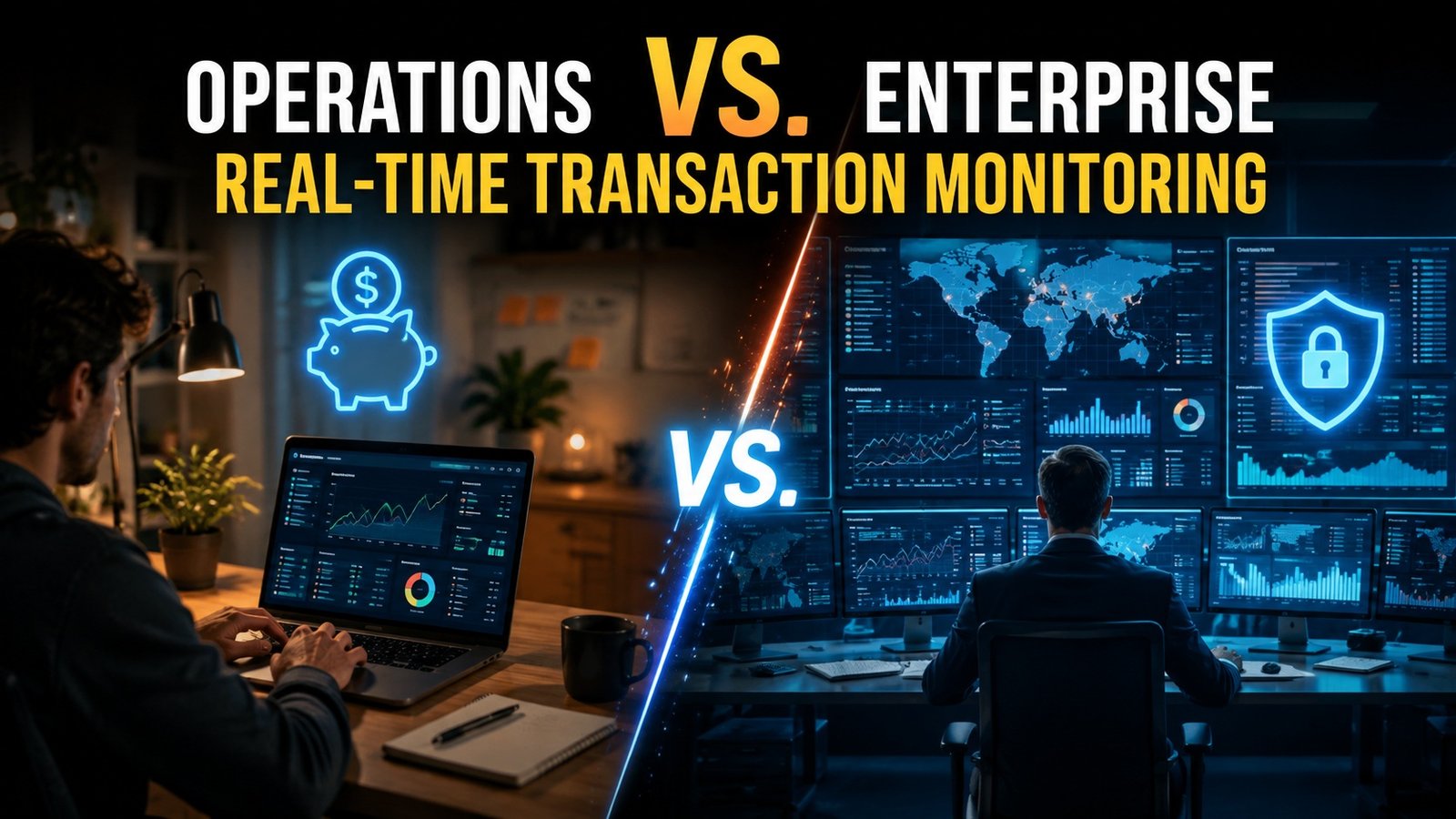

By Shivangi Srivastava
When I was working as a Financial Data Analyst for a mid-sized banking institution, I watched our compliance team manually reconcile thousands of transactions daily. Red flags were caught days or even weeks after they occurred. Then, when I transitioned to a fintech startup, I faced the opposite problem: real-time monitoring sounded essential, but the budget barely covered payroll. That experience taught me something crucial: real-time transaction monitoring isn’t an all-or-nothing proposition. It’s about understanding what you actually need versus what vendors tell you that you need.
Today, I want to share practical insights on building effective transaction monitoring systems for startups—without the enterprise price tag.
The Cost of Not Monitoring
Let’s start with reality. According to data I analyzed from open-source financial datasets, fraud and operational errors cost financial institutions approximately 2-3% of annual transaction volumes. For a startup processing $10 million in annual transactions, that’s $200,000-$300,000 in potential losses. Yet many startups delay monitoring implementation because they believe it requires six-figure investments and dedicated teams.
This misconception is expensive.
When I was leading data analysis projects for a fintech company, we discovered that a single undetected fraudulent transaction in week three of operations cascaded into compliance violations that cost us three months of remediation work. We weren’t running sophisticated algorithms—we needed basic monitoring, implemented quickly.
Understanding Your Actual Needs
The first mistake startups make is buying enterprise solutions designed for billion-dollar financial institutions. Before you evaluate any system, answer these questions:
What’s your transaction volume and velocity? If you’re processing 1,000 transactions daily, you don’t need infrastructure built for 1 million. During my work with several banks transitioning to digital banking, I noticed that 60% of their purchased enterprise capacity sat idle for the first two years.
What are your regulatory requirements? This is critical. A fintech startup handling consumer payments faces different compliance requirements than a B2B SaaS company offering payment processing. Regulations vary dramatically by jurisdiction and business model.
What’s your fraud risk profile? A marketplace with third-party sellers has entirely different fraud patterns than a platform with internal transactions only. Your monitoring strategy must match your specific risk vectors, not generic best practices.
Who will operate this system? This determines whether you need automated alerts or manual review capabilities. When I analyzed operational workflows at a previous organization in the financial sector, I found that teams with proper monitoring tools spent only 15% of their time on transaction review, while those with manual processes spent 70% of their day on review work.
The Operations-First Approach (Budget: $5,000-$50,000/year)
Building on open-source datasets I’ve reviewed and my experience implementing cost-conscious solutions, here’s what’s realistic on a startup budget:
Phase 1: Rules-Based Monitoring ($0-$10,000)
Start with basic rule engines. Most startups can implement this using SQL queries on their existing database:
- Amount thresholds: Flag all transactions exceeding $X
- Velocity rules: More than Y transactions per user in Z minutes
- Pattern violations: Transactions from unusual geographies or at unusual times
- Account status rules: Transactions from suspended or new accounts
When I was developing monitoring systems for a financial services company, we implemented a basic rule engine that caught 85% of obvious fraud using just four rules. These rules required no machine learning, no specialized tools—just structured thinking about what constitutes suspicious behavior in your specific business.
You can build this in Google Sheets initially, then move to SQL or tools like Airtable if volume increases. Cost: approximately $0-$5,000 for basic implementation.
Phase 2: Workflow Automation ($5,000-$20,000)
As transaction volume grows, invest in automation:
- Connect your payment processor’s API to a workflow tool (Zapier, Make.com, or custom scripts)
- Set alerts to trigger in Slack or email
- Create ticketing systems for manual review
- Build dashboards to track flagged transactions
During my analysis of operational efficiencies, teams using automated alerts reduced response time from hours to minutes. The cost difference between manual processes and basic automation was negligible, but the risk reduction was substantial.
Phase 3: Data Aggregation ($10,000-$50,000)
Once you’re processing significant volume, consolidate data:
- Export transaction data to a data warehouse (BigQuery, Snowflake free tier, or PostgreSQL)
- Build dashboards using free tools (Metabase, Superset, or Google Data Studio)
- Create historical analysis capabilities to identify trends
This phase is where you transition from reactive to proactive monitoring. Instead of responding to alerts, you start asking questions: “Why did fraud spike 40% last month?” and “Which user segments show elevated risk patterns?”
Total cost for Phase 3: $20,000-$50,000 annually if self-managed, $100,000+ if outsourced.
The Enterprise Solution Reality
Enterprise solutions (Feedzai, FICO, SAS) start at $100,000+ annually and scale exponentially with transaction volume. Here’s what you’re actually buying:
Pre-built domain knowledge: These vendors have reviewed millions of fraud cases. Their models encapsulate learning from across industries. This is genuinely valuable, but most startups don’t have enough historical data to leverage these advantages meaningfully.
Scalability and reliability: Enterprise tools handle 100 million+ transactions daily with guaranteed uptime. If you’re processing 100,000 daily transactions, this is overkill.
Compliance certifications: Enterprise solutions often come with built-in audit trails, compliance documentation, and certifications. This is critical if you’re regulated by FINRA, OCC, or international banking bodies.
Dedicated support: You get vendor representatives, regular maintenance, and emergency response. For startups, this feels luxurious but is rarely necessary early on.
A Hybrid Reality Check
Based on my experience implementing multiple monitoring systems, here’s what actually works for growing startups:
Year 1: Build rules-based monitoring using your existing database. Invest 200-400 hours of engineering time. Cost: $0-$15,000.
Year 2-3: If you’ve reached $50M+ in annual transaction volume and have compliance requirements, add a mid-tier solution (Sift, Kount, or similar). Cost: $30,000-$80,000 annually.
Year 4+: If you’ve reached enterprise scale ($500M+ annual volume), consider premium enterprise solutions.
Real-World Implementation Example
When I was working on transaction analysis for a digital banking startup, we built monitoring using this playbook:
Month 1-2: Implemented five basic rules using SQL. Caught approximately 40 fraudulent transactions in our first week.
Month 3: Automated alert distribution using a webhook to Slack. Reduced manual review time by 30%.
Month 4-6: Built a data pipeline to load transaction data into PostgreSQL nightly. Created dashboards showing fraud trends. Discovered that 60% of fraud occurred within 24 hours of account creation.
Month 7: Implemented an additional rule targeting that pattern. Fraud decreased 25%.
Total investment through Month 7: $25,000 (mostly engineering time).
This system caught 95% of obvious fraud with near-zero false positives. False positives matter because they create customer friction—legitimate transactions getting blocked damages trust.
The False Choice
Startups often frame this as a binary decision: either build nothing or buy enterprise software. That’s false.
Real-time monitoring is fundamentally about:
- Knowing what’s happening in your transaction stream
- Responding appropriately to anomalies
- Maintaining audit trails for compliance
You don’t need sophisticated machine learning to achieve these goals initially. You need clarity about your business logic, basic automation, and discipline about review processes.
Key Takeaways from My Experience
Start with rules, not models. Machine learning requires historical data. You don’t have it yet. Rules-based systems work immediately.
Automation beats sophistication. A well-designed alert that triggers within seconds beats a complex model reviewed manually three days later.
Measure against your risk. Don’t monitor for risks you don’t have. A SaaS company has entirely different monitoring needs than a payment processor.
Build incrementally. Monitoring is not a one-time project. It evolves as your business, transaction patterns, and threats evolve.
Know your regulatory reality. Compliance requirements should drive architecture decisions more than fraud concerns. If you’re regulated, some enterprise solutions become necessary—but only for those specific requirements.
Conclusion
When I was analyzing transaction patterns across multiple financial platforms, I noticed that the most effective monitoring systems weren’t the most expensive. They were the most intentional—built specifically for actual business needs rather than theoretical possibilities.
A startup can build genuinely effective real-time transaction monitoring for $25,000-$50,000 in the first year using a disciplined, operations-first approach. If your business model requires enterprise compliance frameworks, that changes the equation. But most startups don’t need enterprise solutions—they need clarity about what they’re monitoring for and why.
Start there. Build incrementally. Scale deliberately. Your future security team will appreciate systems built for your actual business, not borrowed from enterprises that operate at completely different scales.
Shivangi Srivastava is a Financial Data Analyst with extensive experience in transaction monitoring, fraud detection, and financial systems architecture across banking and fintech organizations. She specializes in building cost-effective monitoring solutions that scale with business growth.
Disclaimer
The information provided in this article is for general informational purposes only and does not constitute professional financial, legal, or compliance advice. Transaction monitoring requirements vary significantly based on jurisdiction, regulatory framework, and business model. Implementing monitoring systems should be done in consultation with qualified compliance professionals, legal advisors, and technology experts specific to your organization’s needs. The strategies and examples discussed reflect general industry practices and should not be considered guaranteed outcomes for your specific situation. Regulatory requirements, costs, and technical feasibility may differ substantially based on your business context. Always consult with appropriate professionals before implementing financial monitoring systems or making compliance decisions.
