

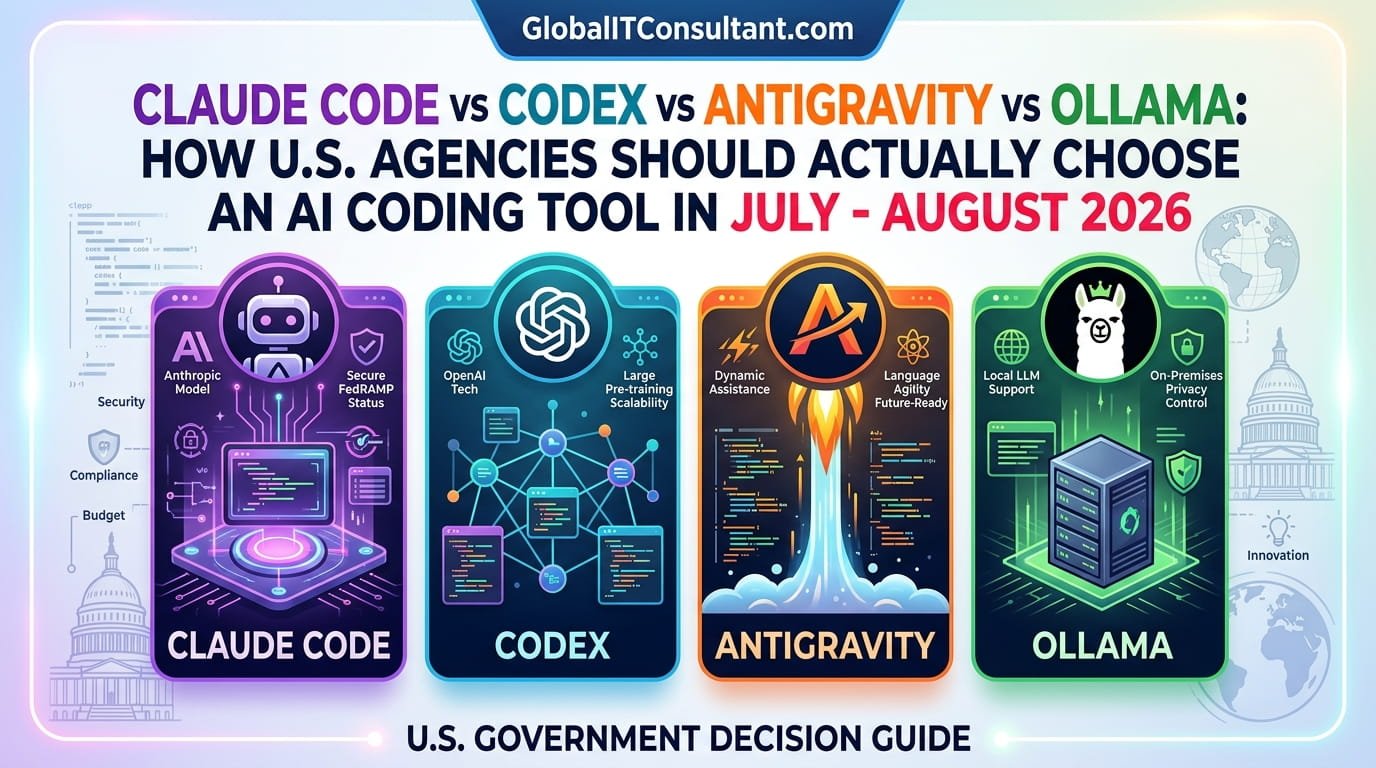

Last Updated: July 2026
Every few weeks, someone on a client’s leadership team asks me a version of the same question, usually right after they’ve read a LinkedIn post from someone insisting their tool is “the one that changed everything.” The question is almost always: “So which AI coding tool should our team actually standardize on?”
I’m Ankit Srivastava, and I’ve spent a genuinely unreasonable amount of time over the past year running real client and internal projects through Ollama’s full model lineup (both local and cloud), raw llama.cpp deployments, Claude Code, ChatGPT’s Codex, Google’s Antigravity, and most of the other agentic coding tools currently getting attention. My honest conclusion, before we go any further: there is no single “best” tool. There’s a best tool for a specific agency, working on a specific kind of project, with specific constraints around budget, data sensitivity, and team structure. Anyone selling you a universal answer is selling you something.
What I can give you instead is a genuinely useful decision framework — built from actually running these tools on real work, not from a press release — along with a detailed, honest comparison so you can make this call for your own agency instead of guessing based on whichever tool trended on social media this week.
Why This Decision Matters More For Agencies Than Solo Developers
A solo developer picking a coding tool is optimizing for one person’s workflow and preferences. An agency choosing a coding tool is making an infrastructure decision that affects client contracts, data handling obligations, billing models, onboarding time for new hires, and consistency across a team that may include senior architects and junior developers working side by side.
Get this decision right, and you get a genuine productivity multiplier across every project you run. Get it wrong, and you either overpay for capability you don’t need, or you standardize on something that quietly creates a client data exposure problem nobody notices until it’s a real issue.
The Decision Framework I Actually Use With Clients
Before touching a comparison chart, I walk agency leadership through four questions, because the answers determine which category of tool even makes sense before we start comparing specific products.
How sensitive is your clients’ code and data? If you work with healthcare, finance, defense, or any client with strict data residency or confidentiality requirements, that alone may push you toward local or self-hosted inference regardless of how good a cloud tool’s raw capability is.
What’s your team’s actual skill distribution? A team of senior engineers who want fine-grained control over every change behaves very differently from a team that wants an agent to handle more of the implementation autonomously while a smaller number of seniors review output.
What’s your billing model? Agencies billing fixed-price projects care about cost predictability and raw throughput. Agencies billing hourly care more about developer experience and accuracy, since time saved translates directly to margin, not just to shipping faster.
How much orchestration do you actually need? A team running one agent on one task at a time has very different needs than a team that wants to run multiple agents in parallel across a project, with a human reviewing and merging outputs.
With those questions in mind, here’s how the major players actually stack up right now.
Quick-Reference Comparison Table
| Tool | Backing Models | Deployment | Best For | Data Privacy | Pricing Model |
|---|---|---|---|---|---|
| Claude Code | Claude Fable 5, Opus 4.8, Sonnet 5 | Terminal-native, cloud API | Autonomous, long-horizon agentic tasks; senior engineering teams | Standard cloud API terms | Subscription (Max) or API/token |
| OpenAI Codex | GPT-5.6 Sol/Luna | Cloud-based, async/batch-friendly | Async, cloud-based batch coding tasks; CI-style workflows | Standard cloud API terms | API/token-based, ChatGPT plan tiers |
| Google Antigravity 2.0 | Gemini 3.5 Flash, 3.1 Pro (also supports Claude, GPT-OSS) | Desktop app, CLI, SDK, multi-agent orchestration | Agencies running multiple agents in parallel on one project | Standard cloud API terms; Cloud enterprise integration | Free tier; AI Ultra at $100/month |
| Cursor | Multi-model (Anthropic, OpenAI, Google, open-weight) | VS Code fork IDE | Teams wanting a familiar IDE with deep AI integration, model flexibility | Standard cloud API terms | Subscription tiers |
| Ollama (local models) | Qwen3 Coder, GLM-4.7/5.2, Gemma 4, DeepSeek Coder, and more | Fully on your own hardware | Regulated industries, offline work, cost-sensitive high-volume tasks | Full data sovereignty — nothing leaves your infrastructure | Free (hardware cost only) |
| Ollama (cloud models) | Kimi K2.6/K3, MiniMax M2.7/M3, and others via :cloud suffix | Ollama’s hosted infrastructure, same CLI/API | Teams wanting Ollama’s unified interface without local hardware limits | Routed through Ollama’s cloud servers | Usage-based |
| Raw llama.cpp | Any GGUF-compatible open-weight model | Fully self-managed, no wrapper tooling | Teams needing maximum control, custom integrations, embedded use cases | Full data sovereignty | Free (hardware/engineering time cost) |
Claude Code: The Choice for Deep, Autonomous Agentic Work
Claude Code remains my default recommendation for agencies whose work involves genuinely complex, multi-file changes where you want an agent that can reason through a problem across an extended session rather than needing constant hand-holding. Running it against real client refactors, I’ve consistently found it handles long-horizon planning and multi-step execution with fewer derailments than most alternatives, particularly on backend and architecture-heavy work.
For an agency, the practical consideration is cost structure — you’re paying for genuine reasoning depth, and that shows up in the bill. This is the right tool for the parts of a project where getting it right the first time matters more than raw throughput.
OpenAI Codex: Strong for Async, Cloud-Native Workflows
Codex has carved out a genuinely useful niche for agencies running async, batch-style coding workflows — the kind of task you kick off, let run in a cloud environment, and come back to review, rather than sitting in an interactive session. If your team’s workflow already leans on CI/CD pipelines and you want an agent that fits naturally into that async model rather than requiring a developer’s active attention throughout, Codex is worth evaluating specifically for that fit, not just as a general Claude Code alternative.
Google Antigravity 2.0: Built for Multi-Agent Orchestration
This is the one I’d flag as most worth serious evaluation for agencies specifically, and it’s evolved fast. What started as an agentic coding IDE has expanded into a genuine multi-agent orchestration platform — a desktop app that acts as a command center for running multiple agents in parallel on the same project, alongside a CLI and SDK for teams that want to build custom agent workflows.
For an agency structure specifically, this matters: instead of one developer running one agent on one task, Antigravity is built around the idea of coordinating several agents simultaneously — one handling implementation, another handling testing or documentation, a third handling a separate module — with a human reviewing and orchestrating rather than doing every step manually. It also supports multiple underlying model providers rather than locking you into a single vendor’s models, and its default Gemini 3.5 Flash model is genuinely fast, which matters when you’re running several agents at once and don’t want to wait on sequential API calls.
The tradeoff is workflow change — this isn’t just swapping your coding assistant, it’s adopting a different way of structuring how work gets distributed across a team (human and AI alike), and that has a real onboarding cost.
Cursor: The Familiar IDE Path
If your team is already deeply embedded in VS Code and you want AI capability layered into that exact environment rather than adopting a new tool paradigm, Cursor remains the lowest-friction option. Its multi-model support means you’re not locked into one provider’s capabilities, and its Composer feature now supports parallel agent execution as well, putting it in more direct competition with Antigravity’s orchestration approach, just from inside a more traditional IDE experience rather than a dedicated agent command center.
For agencies with senior developers who want to stay hands-on with code rather than delegate broadly to autonomous agents, this is usually the more comfortable transition.
Ollama: Where Local and Cloud Genuinely Meet
This is the category I think gets underused by agencies, mostly because “local AI” still carries an outdated reputation as a hobbyist compromise. That’s no longer accurate. Local models running through Ollama on a reasonably modern GPU now handle a genuinely large share of everyday coding tasks — autocomplete, focused edits, code review, test generation — at a quality level close to frontier cloud models, with zero data leaving your infrastructure and no per-token cost beyond your hardware.
Where local models still struggle is exactly where you’d expect: long, complex agent loops involving extensive tool use and hard multi-file debugging across a large, unfamiliar codebase. This is precisely why Ollama’s cloud model option matters — it gives you the same unified interface and CLI you’re already using for local models, but routes specific, harder tasks to more capable hosted models (Kimi, MiniMax, and others) without rebuilding your entire toolchain. For an agency, this hybrid approach is genuinely compelling: route the bulk of routine work locally at effectively zero marginal cost, and escalate only the genuinely hard problems to a paid cloud model.
For agencies with clients in regulated industries — healthcare, finance, government contracting — this local-first approach isn’t just a cost optimization, it’s often a genuine compliance requirement, since keeping client code entirely on your own infrastructure sidesteps a whole category of data processing agreement complexity that cloud-only tools require you to navigate.
Raw llama.cpp: For Teams That Want Full Control
I don’t recommend this path for most agencies, but it’s worth knowing when it makes sense: if you need to embed inference directly into a custom internal tool, need behavior Ollama’s wrapper doesn’t expose, or are optimizing hard for performance on very specific hardware, running llama.cpp directly gives you that control. The tradeoff is engineering time — you’re taking on infrastructure work that Ollama otherwise handles for you, and for most agencies, that time is better spent on client work than on inference infrastructure maintenance.
How I’d Actually Recommend an Agency Decide
For an agency doing high-stakes, complex custom development for well-resourced clients, I’d lead with Claude Code for the hardest architectural work, paired with Ollama local models for the high-volume, routine coding tasks that don’t need frontier-level reasoning — keeping costs proportional to task difficulty rather than paying premium rates for every line of code.
For an agency structured around parallel workstreams and looking to genuinely scale output per developer, Antigravity’s orchestration model is worth a real pilot project, not just a demo — the workflow shift has a learning curve, but the payoff for the right team structure is real.
For an agency working with regulated-industry clients where data residency is non-negotiable, start your evaluation with Ollama’s local model lineup and treat cloud tools as a fallback for the specific tasks local models genuinely can’t handle well, rather than the default.
For an agency that’s cost-sensitive and running a lot of routine, repetitive coding work across many small client projects, Ollama’s local-plus-cloud hybrid approach will likely deliver the best cost-to-output ratio of anything on this list.
The Mistake I See Agencies Make Most Often
The single most common mistake isn’t picking the “wrong” tool — it’s picking one tool and forcing every task through it regardless of fit. The agencies getting the best results right now are the ones treating this as a portfolio decision, not a single-vendor decision: routine work routed to cheap or local models, complex architectural work routed to frontier reasoning models, and orchestration tools layered on top when a project genuinely benefits from running multiple agents in parallel. Standardizing on one tool for operational simplicity is a reasonable choice for a small team, but it’s rarely the choice that maximizes either cost efficiency or output quality for an agency handling varied client work.
Final Thoughts
None of these tools are static targets — Claude, OpenAI, and Google are all shipping meaningful updates to their coding agents on a monthly cadence right now, and Ollama’s local model ecosystem is improving just as fast on the open-weight side. The right move for most agencies isn’t picking one winner and committing permanently — it’s building a genuine evaluation habit, revisiting this decision quarterly, and structuring your workflow so switching or adding a tool doesn’t require rebuilding your entire process from scratch.
If you want help actually running this evaluation for your agency — mapping your specific client mix, data sensitivity requirements, and team structure against the right combination of these tools — that’s exactly the kind of practical, hands-on consulting engagement I run through GlobalITConsultant.com.
