


By Sameer C, Co-Founder – GlobalITConsultant.com
Technology has always reshaped how businesses and consumers interact, but some shifts redefine entire landscapes. One such transformation currently underway is the rise of voice search. From asking Alexa about the weather to using Siri to find the nearest restaurant, voice assistants have become part of daily life in the United States.
For U.S. businesses, this evolution signals more than convenience; it represents a new frontier in digital visibility, customer engagement, and sales growth. If the last decade was about mobile-first strategies, the next will be dominated by voice-first optimization.
In this article, I’ll explore why voice search is exploding in popularity, how it changes consumer behavior, and — most importantly — how U.S. businesses can optimize for it today.
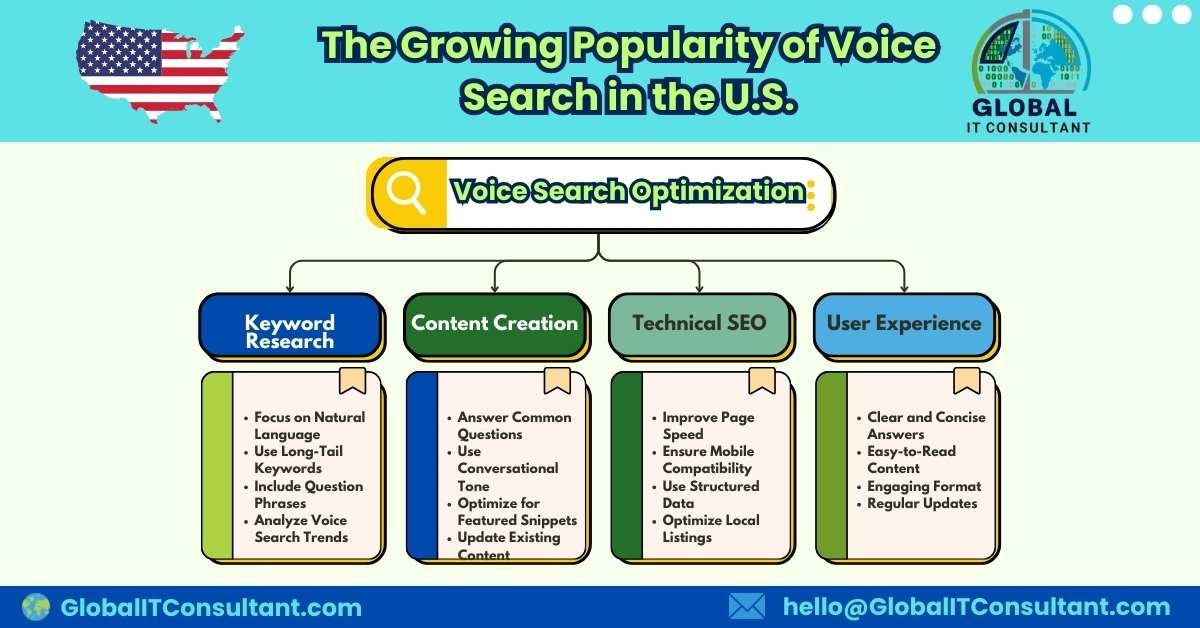
The Growing Popularity of Voice Search in the U.S.
Voice search adoption in the U.S. has accelerated thanks to three factors:
- Smart Device Penetration – Over 120 million Americans own smart speakers such as Amazon Echo or Google Home, while nearly every smartphone now comes with a voice assistant built-in.
- Convenience and Speed – Speaking is faster than typing. Consumers use voice search for quick answers, directions, or shopping needs.
- Improved Accuracy – Natural language processing (NLP) has made voice assistants significantly better at understanding complex, conversational queries.
According to recent reports, more than half of U.S. consumers use voice search daily — and businesses ignoring this shift risk losing visibility to competitors who adapt early.
Why Voice Search Matters for U.S. Businesses
Unlike traditional text searches, voice queries are longer, more conversational, and often intent-driven. For example:
- Typed Search: “best pizza NYC”
- Voice Search: “What’s the best family-friendly pizza place near me open right now?”
This change means businesses must rethink content, SEO, and customer engagement strategies. Voice search matters because:
- Local Businesses Gain Priority – “Near me” searches dominate voice queries, offering brick-and-mortar businesses new opportunities.
- Higher Conversion Intent – Voice queries are often made on-the-go and close to purchase decisions.
- Customer Expectations Are Rising – Americans expect instant, accurate, and context-aware responses.
In short: Optimizing for voice search isn’t optional anymore — it’s a competitive necessity.
Key Differences Between Voice and Text Search
To effectively optimize, businesses must understand how voice queries differ from typed searches:
- Length & Conversational Tone – Voice queries average 6–10 words versus 2–3 in text.
- Question-Based – Voice queries often begin with who, what, where, when, why, or how.
- Local Intent – More than 55% of U.S. voice searches are local in nature.
- Device Context – Many searches happen on mobile or smart speakers, impacting results displayed.
- Featured Snippets – Voice assistants often read answers directly from Google’s “position zero,” making snippet optimization critical.
How U.S. Businesses Can Optimize for Voice Search
Here’s a structured step-by-step strategy:
1️⃣ Focus on Conversational Keywords
Traditional SEO emphasizes short-tail keywords, but voice search is driven by natural, long-tail phrases. For instance:
- Instead of targeting “digital marketing agency,” optimize for “Which is the best digital marketing agency in Washington, D.C.?”
Action Tip: Use tools like AnswerThePublic or SEMrush’s Question Filter to identify question-style keywords.
2️⃣ Optimize for Local Search
Voice searches frequently include “near me” or “open now.” U.S. businesses should:
- Claim and optimize their Google Business Profile.
- Ensure NAP consistency (Name, Address, Phone number) across all directories.
- Add localized FAQs and content mentioning city, state, and neighborhood keywords.
3️⃣ Build an FAQ Page
Since voice searches are question-heavy, creating a structured FAQ page increases chances of ranking for those queries.
Example for an IT consulting firm:
- “How much does cloud migration cost for small businesses?”
- “What’s the best cybersecurity solution for remote teams in the U.S.?”
4️⃣ Target Featured Snippets
Voice assistants often read the featured snippet aloud. To capture these:
- Use structured data (schema markup).
- Provide clear, concise answers (40–60 words).
- Format content with headings, bullet points, and lists.
5️⃣ Improve Mobile and Page Speed Performance
Most voice searches happen on smartphones. If your site loads slowly, you risk losing that traffic.
Action Tip:
- Use Google PageSpeed Insights to identify issues.
- Implement AMP (Accelerated Mobile Pages) where applicable.
6️⃣ Embrace Multimodal Content
Smart speakers without screens rely on audio answers, but many devices (like Echo Show or Google Nest Hub) also display visual content. Businesses should optimize both:
- Short, scannable text for display.
- Engaging audio responses through structured content.
7️⃣ Integrate Voice Search into E-Commerce
Voice commerce is booming in the U.S. Consumers increasingly say:
- “Order paper towels from Amazon.”
- “Find the cheapest iPhone case available.”
E-commerce businesses should:
- Enable voice shopping integrations.
- Optimize product descriptions for conversational queries.
- Ensure smooth checkout through mobile-first design.
8️⃣ Prioritize Accessibility and Inclusivity
Voice search also opens digital access to people with disabilities. By optimizing for voice, businesses serve a broader audience while aligning with inclusivity goals.
Voice Search by Industry: U.S. Use Cases
Different industries in the U.S. can leverage voice search uniquely:
- Healthcare: Patients ask for nearby clinics, symptoms, or doctor availability.
- Retail: Shoppers request deals, product comparisons, or restock reminders.
- Hospitality: Travelers look for hotels “near me” with specific amenities.
- Financial Services: Clients ask for account details, investment rates, or financial advice.
- Education & Training: Learners request courses, schedules, and quick knowledge checks.
Best Practices for Long-Term Success
- Regularly Update Content – Consumer language evolves; keep FAQs current.
- Leverage AI Tools – Natural language generation helps predict how people ask questions.
- Measure and Refine – Track voice search traffic in Google Search Console and adapt.
- Align with Core SEO – Voice optimization complements, not replaces, traditional SEO.
- Invest Early – The sooner you adapt, the stronger your competitive edge.
Challenges Businesses Must Address
While voice search is promising, U.S. businesses should prepare for challenges:
- Accuracy Concerns – Assistants sometimes misinterpret queries.
- Privacy Issues – Consumers remain cautious about data collection.
- Limited Analytics – Tracking exact voice queries is still evolving.
- Technology Adoption Gaps – Older demographics may adopt slower.
Acknowledging these helps set realistic expectations while planning long-term strategies.
The Future of Voice Search in the U.S.
Looking ahead, voice search will integrate deeper into everyday business and consumer life:
- AI Assistants as Gatekeepers – Instead of browsing, users will rely on assistants to curate options.
- Voice + AI Shopping Agents – Automated, voice-driven purchases will become routine.
- Multilingual Optimization – With America’s diverse population, Spanish-language voice search will grow.
- IoT Integration – Appliances, cars, and wearables will all become search-enabled.
For businesses, the message is clear: voice search isn’t just a trend, it’s the next digital revolution.
Final Thoughts
In my years of helping businesses adopt cutting-edge technologies, I’ve seen that those who adapt early to paradigm shifts always outperform those who wait. Voice search optimization is one of those shifts.
For U.S. businesses, it represents a chance to:
- Be discovered faster.
- Build stronger local connections.
- Improve accessibility and inclusivity.
- Unlock new revenue streams through voice commerce.
At GlobalITConsultant.com, we guide organizations in aligning with the next wave of digital transformation — from cloud adoption to AI-driven analytics. Voice search optimization is no exception. Businesses that invest in it today will lead their industries tomorrow.
The question isn’t if your customers will search by voice — it’s whether they’ll find you when they do.
