


By Sameer C, Data Analyst
1. Introduction: Why Team Location Matters for U.S. Startups
In today’s fast-moving digital economy, a startup’s ability to build and deliver software quickly is often the difference between leading a market and missing an opportunity. Across the United States, demand for skilled engineers continues to rise, driven by the growth of AI, cloud computing, cybersecurity, automation, and data-centric products. Yet the supply of domestic tech talent has not kept pace. Many startups face hiring bottlenecks, higher competition from big tech employers, and rising salary expectations even for mid-level roles.
This environment makes team location strategy a crucial decision in 2026. Founders must balance speed, cost, expertise, and scalability—even before writing the first line of code. Whether your product requires rapid prototyping, complex engineering, or continuous iteration, the choice between onshore and offshore teams directly affects quality, collaboration, and long-term agility.
In my 15+ years of working with global development teams and overseeing hybrid delivery models, I’ve seen that there is no universal “right” answer. Instead, the right team location depends heavily on the startup’s priorities, runway, and product roadmap. Understanding how each model works—and the trade-offs involved—is the first step to making a smart, future-proof decision.
2. What Is an Onshore Software Team?
An onshore software team refers to developers, designers, project managers, and engineers who are located within the United States. These teams typically work in the same or nearby time zones, share the same business culture, and have easier access to in-person engagement when needed.
Key Benefits of Onshore Teams
- Stronger communication and real-time collaboration: Same-day work cycles allow for iterative development and faster decision-making.
- Deep understanding of U.S. regulations and business norms: This is especially critical for healthcare, fintech, defense, and government projects.
- Easier integration with internal teams: Cultural alignment often leads to smoother teamwork and fewer misinterpretations.
- Higher accountability and IP protection: U.S. legal frameworks make compliance and governance more predictable.
Limitations of Onshore Teams
- Significantly higher costs: Salaries for experienced engineers in the U.S. have risen dramatically, especially in metro cities.
- Talent scarcity: Finding senior developers or niche specialists (AI, ML Ops, Cloud Security) can take months.
- Slower scaling: Expanding an onshore engineering team rapidly is often difficult due to local talent bottlenecks.
Typical U.S. Engagement Models
- Full-time in-house hiring
- U.S.-based software development agencies
- Staff augmentation firms
- Onshore managed service providers
Onshore teams offer exceptional alignment and quality—but at a premium price.
3. What Is an Offshore Software Team?
An offshore software team consists of professionals located outside the United States, often in well-established global tech hubs known for engineering talent and competitive pricing.
Popular Offshore Locations in 2026
- India – Massive talent pool, strong cloud/AI/data engineering expertise
- Eastern Europe (Poland, Romania, Ukraine) – High-quality engineers, excellent English proficiency
- Latin America (Colombia, Brazil, Argentina) – Nearshore advantages with lower costs
- Philippines & Vietnam – Growing engineering talent and strong support functions
Why Offshore Development Has Become Mainstream
The global tech ecosystem has matured. Many offshore teams now operate with Silicon-Valley-level skill sets, modern Agile practices, and strong English communication. Cloud-native development, DevOps, automation, and remote productivity tools have eliminated traditional challenges around visibility and delivery.
Moreover, offshore models allow U.S. startups to extend their runway, build minimum viable products faster, and access specialized talent without long recruitment cycles.
Benefits
- Substantial cost savings
- Access to large talent pools
- Faster hiring and scaling
- Ability to run 24/7 operations using time zone differences
Challenges
- Cultural differences
- Time zone gaps depending on region
- Need for strong documentation and structured project management
Despite these considerations, offshore models continue to grow because they help early-stage companies develop high-quality products without exceeding budget constraints.
4. Cost Comparison: Onshore vs Offshore Development
For most U.S. startups, cost is one of the strongest factors influencing team location.
Onshore Cost Structure (U.S.)
Typical salary or agency rates for experienced engineers:
- Senior Developer: $140k – $200k+ / year
- Lead Engineer / Architect: $180k – $250k+ / year
- U.S. agency rates: $120 – $220/hour
In high-cost cities like San Francisco, New York, and Seattle, costs can be even higher.
Offshore Cost Structure
Rates vary by region:
- India: $20 – $60/hour
- Eastern Europe: $35 – $80/hour
- Latin America: $30 – $75/hour
A fully offshore team can reduce development expenses by 50–70%, which often extends a startup’s runway by months—or even years.
Overall Comparison
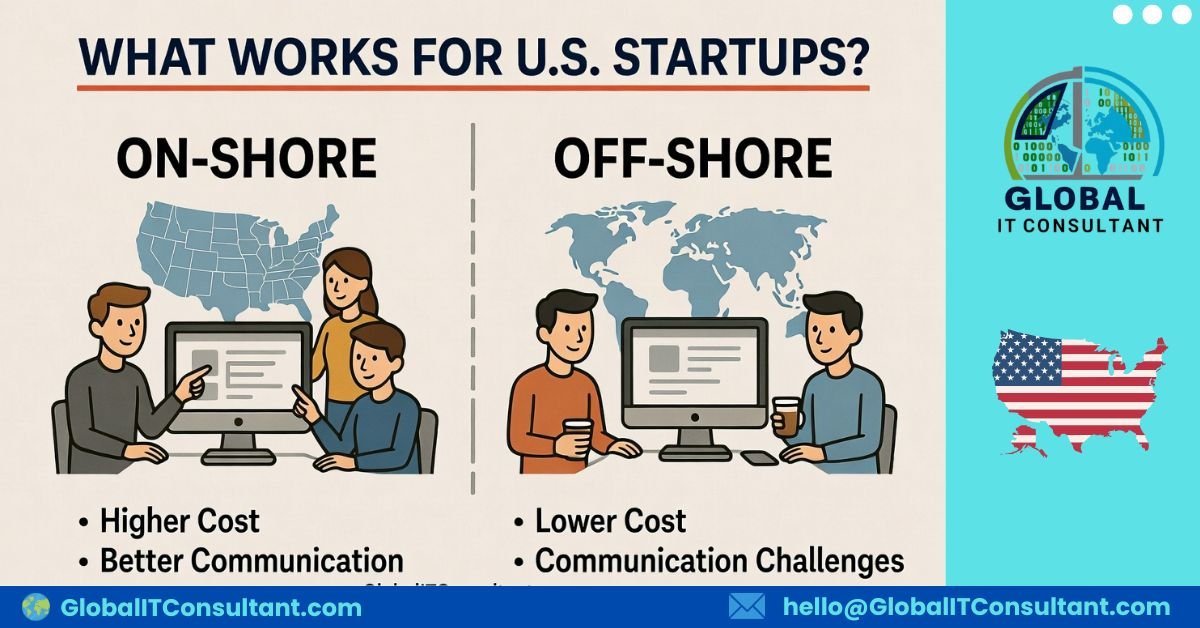
- Onshore = Premium cost + faster collaboration
- Offshore = Lower cost + larger talent pool but higher coordination needs
Startups must evaluate budget, speed, and complexity to determine the ideal mix.
5. Talent Quality and Skill Availability
Both onshore and offshore markets offer strong talent—but availability and specialization vary.
Onshore Talent Strengths
- Deep expertise in regulated industries (healthcare, finance, aerospace)
- Strong product thinking and system architecture
- Business-first mindset aligned with U.S. product expectations
Offshore Talent Strengths
- Massive pools of engineers skilled in AI, cloud, full-stack, automation, data engineering, and mobile app development
- Faster availability of senior specialists
- Mature tech ecosystems in major outsourcing regions
For niche technologies (e.g., blockchain, GenAI integration, advanced DevOps), offshore markets often provide quicker access to experienced engineers than the U.S. hiring market.
6. Communication, Time Zone, and Collaboration Factors
Team communication remains one of the most important considerations when choosing onshore or offshore teams.
Onshore Collaboration Advantages
- Full overlap of working hours
- Immediate response times
- Easier in-person meetings
- Stronger cultural and language alignment
This results in faster iteration and rapid problem-solving—ideal for MVPs or early-stage pivoting.
Offshore Communication Dynamics
Time zone differences can be both a challenge and a productivity advantage.
For example:
- India works well with U.S. teams through a 2–4 hour overlap, plus overnight development cycles.
- Latin America aligns closely with U.S. work hours—ideal for real-time collaboration.
Best Practices for Offshore Collaboration
- Clearly defined documentation
- Daily check-ins and sprint reviews
- Strong project management tools
- Dedicated product owners to bridge the gap
When managed effectively, cross-border collaboration can be seamless and highly efficient.
Here are Chapters 7–15 written in Sameer C’s voice, continuing seamlessly from the earlier sections. The tone stays strategic, analytical, and experience-driven.
7. Speed, Agility, and Time-to-Market
For U.S. startups, time-to-market often determines survival. Whether you’re validating an MVP or scaling a product post-funding, speed is everything.
Onshore Teams: Speed Advantages
- High availability for real-time brainstorming
- Faster approvals and shorter feedback loops
- Easier alignment with product managers and founders
This model is ideal for early-stage products that require continuous iteration.
Offshore Teams: Speed Advantages
- Ability to operate in follow-the-sun model
- Overnight builds and faster development cycles
- Ability to scale quickly without long recruitment delays
When processes are clearly defined, offshore teams can often deliver faster because work can continue long after U.S. teams sign off.
Which Is Faster Overall?
- Onshore = Faster collaboration
- Offshore = Faster execution
- Hybrid = Fastest end-to-end delivery
The most agile startups in 2026 use a combination of both.
8. Security, Compliance, and IP Protection
Security is one of the biggest concerns for founders evaluating offshore development. With increasing data breaches and strict regulations like HIPAA, PCI-DSS, SOC2, and GDPR, protecting user data is non-negotiable.
Onshore Security Strengths
- Stronger regulatory alignment
- Clearer legal protections
- Easier oversight of development processes
Offshore Security Reality Today
Reputable offshore firms now follow global standards:
- ISO 27001
- SOC2 compliance
- Encrypted environments
- Secure access protocols
The key is selecting a vendor with robust security credentials—not the lowest bidder.
IP Protection Measures
- Strong NDAs
- U.S. legal jurisdiction clauses
- Encrypted development pipelines
- Role-based access control
- Private repositories with strict audits
With the right structure, offshore teams can be just as secure as onshore teams.
9. Project Management Challenges and Solutions
Managing a distributed team requires discipline. The biggest challenges occur when communication is unclear or the project lacks structure.
Common Challenges
- Misaligned expectations
- Ambiguous requirements
- Long feedback cycles
- Insufficient documentation
Best Practices for Success
- Adopt modern Agile frameworks
- Use standardized tools (Jira, Notion, Trello, GitHub, CI/CD pipelines)
- Daily standups + weekly sprint reviews
- Clearly defined roles and RACI matrix
- Dedicated Product Owner to reduce friction
A well-run offshore team can outperform an unstructured onshore team. The management layer is often the deciding factor.
10. When Onshore Teams Are the Right Choice
Certain types of products and industries benefit more from onshore teams despite higher costs.
Best Scenarios for Onshore
- Highly regulated sectors: Health-tech, fintech, government, defense
- Complex enterprise integrations with sensitive data
- MVPs or early experimentation where rapid iteration is essential
- Products requiring deep customer understanding (B2B SaaS, government solutions)
If your product requires tight collaboration with stakeholders or domain experts, onshore is often the safest and most effective path.
11. When Offshore Teams Are the Better Option
Offshore teams make the most sense when you need cost efficiency and scale.
Best Scenarios for Offshore
- Long-term development projects (multi-year software builds)
- AI, cloud, automation, and data-heavy projects where global talent is abundant
- Startups with limited runway who must build fast without burning capital
- Businesses that need to scale engineering teams rapidly
Offshore teams are ideal for startups transitioning from concept → MVP → production → continuous development.
12. The Rise of Hybrid (Onshore + Offshore) Teams
In 2026, the hybrid model is quickly becoming the dominant approach for U.S. startups.
How the Hybrid Model Works
- A small core team works onshore (PM, Product Owner, Architect).
- A larger engineering team functions offshore.
- Leadership handles product decisions; offshore teams handle execution.
Hybrid Advantages
- Best of both worlds: speed + affordability
- Real-time U.S. communication with overnight development
- Higher quality due to dual-team oversight
- Easy to scale without losing control
This model is particularly effective for seed- and Series A–level startups looking for efficiency and predictable costs.
13. Real-World Startup Examples (Fictional but Insightful)
Case 1: Onshore Success
A U.S.-based healthcare startup used an onshore team for its MVP due to HIPAA compliance concerns. Faster communication enabled them to launch quickly and secure funding.
Case 2: Offshore Success
A fintech startup outsourced a full-stack engineering team to India and Eastern Europe. They built a complex AI engine at one-third the cost of U.S. development.
Case 3: Hybrid Success
A SaaS startup maintained a U.S.-based PM + architect while building features offshore. Their hybrid model cut development expenses by 60% and doubled their delivery speed.
These examples illustrate that success depends on choosing the right model—not just the cheapest one.
14. Key Criteria for Choosing the Right Model
Before deciding, U.S. founders should evaluate:
1. Budget
How much runway do you want to preserve?
2. Project Complexity
Is the product innovative, experimental, or compliance-heavy?
3. Speed Requirements
Do you need real-time collaboration or 24-hour development cycles?
4. Talent Needs
Are you looking for niche skills or readily available engineers?
5. Communication Expectations
How comfortable is your team with asynchronous communication?
6. Long-Term Scaling Plans
Will you need to double or triple the team in the next year?
A structured evaluation ensures that you choose the model that drives long-term value.
15. Conclusion: Choosing the Smartest Team Structure for 2026
As U.S. startups navigate a highly competitive and rapidly shifting digital landscape, the location strategy for software development has become more important than ever. Onshore teams offer unmatched collaboration, regulatory alignment, and communication ease. Offshore teams deliver cost efficiency, scalability, and access to global expertise. Hybrid teams represent the future—combining the strengths of both models to deliver speed, quality, and cost balance.
The smartest U.S. startups in 2026 approach team location as a strategic decision, not a budget line item. They build for the long-term—aligning talent, processes, and delivery models to accelerate innovation while preserving financial flexibility.
Ultimately, the right choice depends on your goals, constraints, and product vision. When managed well, any model—onshore, offshore, or hybrid—can drive exceptional outcomes.
